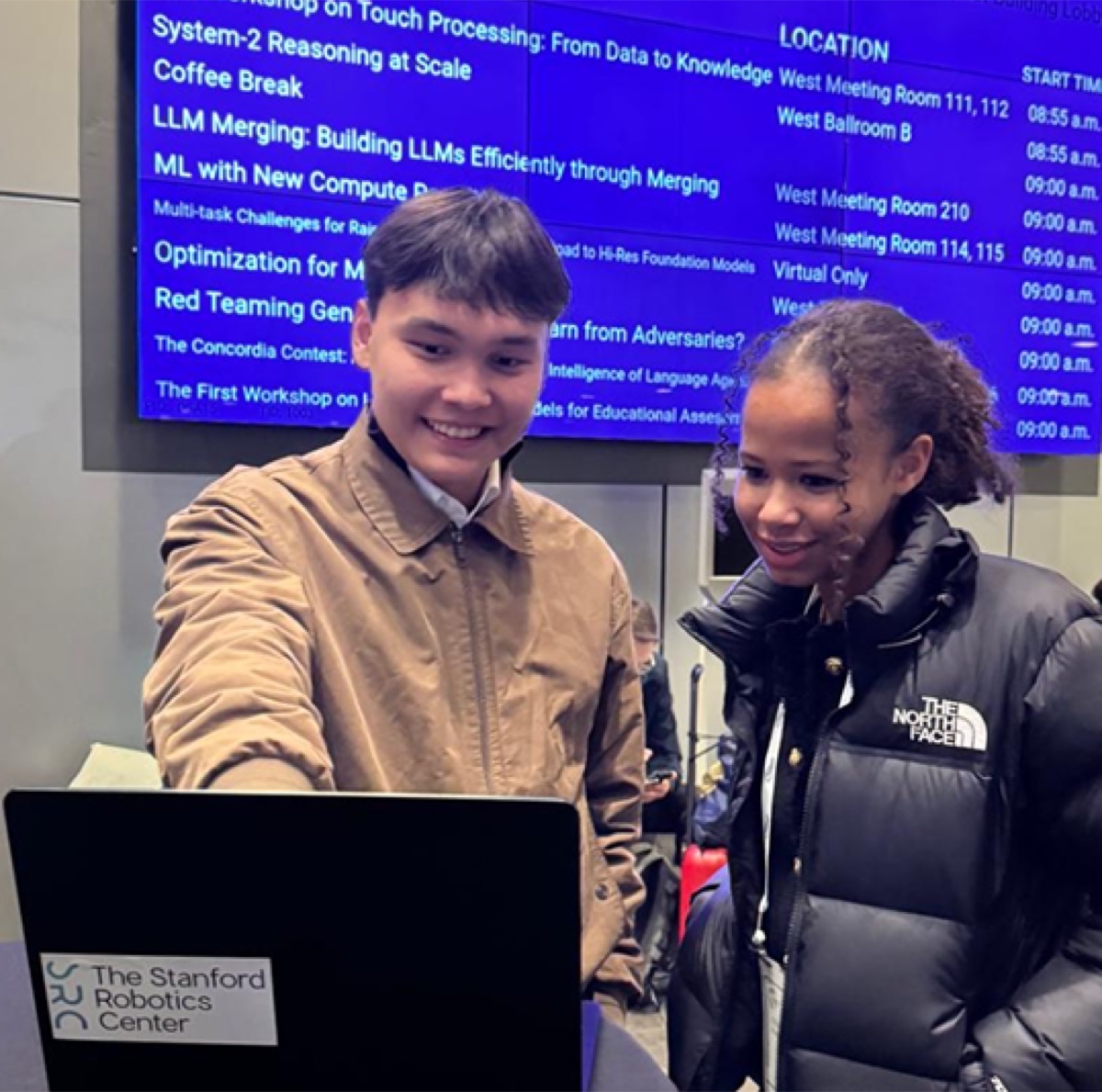
You are sitting in AP Computer Science, and somewhere between learning about for-loops and sorting algorithms, a thought hits you: people not much older than me are publishing papers that shape how AI actually works. And then the follow-up thought: could I do that?
Yes. You can. But not in the way most people think.
AI research is not reserved for PhD students in windowless labs. In 2025 alone, hundreds of high school students published original research at venues like NeurIPS, ICML, and ICLR --- the same conferences where researchers from Google DeepMind, Meta, and OpenAI present their work. Some of these students had never written a line of Python twelve months earlier.
This guide is the honest version of how to make that happen. No hype, no shortcuts, no "just follow your passion and doors will open." What follows is a practical, step-by-step breakdown of how real high school students go from zero to published AI researcher.
What Does AI Research Actually Look Like?
Before you dive in, let's kill the biggest misconception: AI research is not primarily about coding.
Yes, you will write code. But the core of research is asking good questions and rigorously testing answers. A typical research workflow looks something like this:
- Read existing papers to understand what has already been tried and what gaps remain.
- Identify a specific problem --- something narrow enough to actually tackle, like "current text summarization models lose factual accuracy on long documents."
- Form a hypothesis --- a concrete, testable claim about how to improve on the current state of things.
- Design experiments --- build or modify a model, run it on benchmark datasets, and collect results.
- Analyze and write up --- interpret what your results mean, compare to existing work, and write a paper explaining your contribution.
The ratio is roughly 40% reading and thinking, 30% experimenting and debugging, 20% writing, and 10% everything else. If you love building things AND you are the kind of person who asks "but why does that work?" --- research might be a great fit.
Prerequisites You Actually Need
Here is where people psych themselves out. They assume AI research requires PhD-level math, years of programming experience, and some kind of innate genius. It does not.
What you genuinely need:
- Math fundamentals. Linear algebra (vectors, matrices, matrix multiplication), basic probability (distributions, Bayes' theorem), and introductory calculus (derivatives, chain rule). If you are in or have completed precalculus, you can learn the rest as you go.
- Python. Comfortable enough to write functions, work with libraries, and debug error messages without panicking. You do not need to be a competitive programmer.
- Curiosity and tolerance for confusion. Research means spending days stuck on problems. That is the job, not a sign you are bad at it.
What you do NOT need:
- A perfect GPA or test scores
- Prior research experience
- Access to expensive hardware (Google Colab gives free GPU access)
- To have taken AP Calculus BC (though it helps)
- To understand every equation in every paper you read
If you have taken or are taking AP CS and any math course at the precalculus level or above, you have enough of a foundation to start building.
Step 1: Build Your Foundation
You need two parallel tracks here: technical skills and research literacy. Both matter, and neither alone is sufficient.
Learn Python and ML Basics
Start with practical, project-based learning. Theory-first approaches (reading a textbook cover to cover) tend to kill motivation before you get to the interesting parts.
Recommended path (in order):
- 3Blue1Brown's "Neural Networks" series (YouTube, free) --- Beautiful visual explanations of how neural networks actually work. Watch this first. It takes a few hours and will give you intuition that textbooks take weeks to build.
- fast.ai's "Practical Deep Learning for Coders" (free) --- Starts with working code and peels back layers of abstraction over time. Designed for people who learn by doing.
- Andrew Ng's Machine Learning Specialization on Coursera (free to audit) --- More structured and theoretical. Good for filling in gaps after you have some hands-on experience.
Do not try to complete all three before moving forward. Finish the 3Blue1Brown series and get through the first 3-4 lessons of fast.ai, then start reading papers in parallel.
Start Reading Papers
This is where most beginners stall. ML papers look intimidating. Dense notation, unfamiliar terminology, walls of equations. Here is how to get past that:
The three-pass method:
- First pass (5-10 minutes): Read the title, abstract, introduction, and conclusion. Skip everything in between. Goal: understand what the paper does and why it matters.
- Second pass (30-60 minutes): Read the full paper but skip proofs and complex derivations. Focus on figures, tables, and the experimental setup. Goal: understand how they did it and whether the results are convincing.
- Third pass (only for papers directly relevant to your work): Go line by line. Reproduce key results if possible.
Where to find papers:
- arXiv.org --- Free preprint server. All major ML papers land here, often months before official conference publication.
- Papers With Code --- Links papers to their code implementations. Extremely useful for understanding what a paper actually does versus what it claims to do.
- Conference proceedings --- Browse accepted papers from NeurIPS, ICML, ICLR, ACL, CVPR. The workshop tracks are especially accessible.
Start with 2-3 papers per week. It will feel painfully slow at first. By month three, you will be reading them significantly faster.
Step 2: Find Your Research Area
AI is enormous. You need to narrow down, or you will drown in possibilities. Here are the major subfields and what working in each actually involves:
Natural Language Processing (NLP): Working with text and language. Projects might involve improving how models handle ambiguity, reducing hallucinations in language models, or building better evaluation benchmarks. Heavy use of transformer architectures and large datasets.
Computer Vision (CV): Teaching machines to understand images and video. Projects range from medical image analysis to autonomous driving perception to video generation. If you are visual and enjoy working with image data, this is a natural fit.
Reinforcement Learning (RL): Training agents to make sequences of decisions. Think game-playing AI, robotics control, or resource optimization. Mathematically heavier than NLP or CV, but the results are often more tangible and satisfying.
AI Safety and Alignment: Ensuring AI systems behave as intended and remain under human control. This is one of the fastest-growing subfields and has a lot of open, approachable problems --- things like detecting when a model is being deceptive or designing better evaluation frameworks.
Fairness, Bias, and Ethics: Studying and mitigating the ways AI systems can perpetuate or amplify societal biases. Involves both technical work (debiasing algorithms, fairness metrics) and interdisciplinary thinking.
Healthcare AI: Applying ML to medical diagnosis, drug discovery, or clinical decision support. Often involves working with tabular data and domain-specific constraints. If you are pre-med AND interested in CS, this intersection is powerful.
How to choose: Do not overthink this. Read 5-10 papers from 2-3 areas that sound interesting. Whichever one makes you want to keep reading --- that is your area. You can always switch later.
Step 3: Find a Mentor
This is the single highest-leverage step. A good mentor compresses years of trial and error into months of directed effort. They know which problems are tractable, which methods are worth trying, and how to frame your work for publication.
Option 1: Cold-email university professors or PhD students
This works more often than you would expect --- maybe 5-10% response rate --- but you need to do it right.
Template that works:
Subject: High school student interested in [specific topic] research
Dear Professor [Name],
I am a high school [junior/senior] at [School] interested in [specific research area]. I recently read your paper "[Paper Title]" and was particularly interested in [specific aspect --- be genuine, reference something real].
I have been studying [relevant coursework/self-study] and have experience with [relevant skills --- Python, PyTorch, specific datasets]. I have attached [a small project, a paper summary, or a code sample] that demonstrates my current level.
Would you be open to a brief conversation about potential research opportunities in your lab? I am available [timeframe] and can commit [X] hours per week.
Thank you for your time, [Your name]
What makes this work: Specificity. Reference a real paper. Show you have done homework. Attach something concrete. Most cold emails fail because they are generic --- "I am passionate about AI and would love to work with you" tells the professor nothing.
Send 20-30 of these. Expect 1-3 responses.
Option 2: University summer programs
Programs like MIT PRIMES, Stanford SIMR, and RSI are excellent but extremely competitive. Apply, but do not make them your only plan.
Option 3: Structured research programs
Programs like Algoverse pair students directly with research mentors --- often PIs from labs at Meta FAIR, OpenAI, and Google DeepMind --- and guide you through the full cycle from idea to publication. The advantage here is structure: you get a mentor, a cohort, and a clear timeline, which removes a lot of the ambiguity that makes solo research hard at the high school level.
Step 4: Start a Research Project
You have the skills. You have a mentor (or at least a research area). Now you need to actually do something. Here is how a research project typically unfolds:
Weeks 1-3: Literature review. Read 15-25 papers in your specific sub-area. Build a mental map of what exists, what works, and where the gaps are. Maintain a simple spreadsheet: paper title, key idea, results, limitations.
Weeks 4-5: Define your research question. This is harder than it sounds. A good research question is:
- Specific enough to answer in 3-6 months
- Novel enough that nobody has done it exactly this way
- Feasible with the compute and data you have access to
Bad question: "How can we make language models better?" Good question: "Does adding retrieval augmentation to small language models improve factual accuracy on domain-specific medical Q&A benchmarks?"
Weeks 6-12: Experiments. Build your pipeline, run experiments, analyze results. Expect your first approach to not work. This is normal. Research is iterative --- you will likely pivot your method 2-3 times before landing on something that produces interesting results.
Weeks 13-16: Writing. Structure your paper following standard ML conventions: Abstract, Introduction, Related Work, Method, Experiments, Results, Discussion, Conclusion. Your mentor will be invaluable here.
The most important mindset shift: In school, you learn things that are already known. In research, you are trying to figure out something nobody knows yet. That means there is no answer key. You will feel lost. That feeling is not failure --- it is the actual texture of doing research.
Step 5: Publish Your Work
You have a paper draft. Now what?
Conference workshops are the most realistic first target for high school researchers. Major ML conferences (NeurIPS, ICML, ICLR, AAAI, ACL, CVPR) host dozens of workshops on specific topics. Workshop papers are typically 4-8 pages (shorter than main conference papers), the review process is faster, and the acceptance rates are more forgiving --- though the work still needs to be solid.
The submission process:
- Find relevant workshops. Check conference websites 2-4 months before the event. Look for workshop calls for papers that match your topic.
- Format your paper. Each conference has a LaTeX template. Use it. Formatting errors are an easy way to get desk-rejected.
- Submit through OpenReview or CMT. These are the standard submission platforms. Your mentor can walk you through the process.
- Handle reviews. If your paper gets reviews, you will likely need to revise and respond. Reviews can be blunt. Do not take it personally --- even senior researchers get harsh reviews.
arXiv preprints are another option. You can post your paper on arXiv at any time without peer review. It gets your work out there and establishes a timestamp on your ideas, but it does not carry the same weight as a peer-reviewed workshop or conference paper.
If your paper gets rejected: Welcome to research. Rejection rates at top venues are 70-80% even for experienced researchers. Read the reviews carefully, improve your paper, and submit to the next deadline. Many papers that eventually get accepted were rejected at least once first.
Paths After Your First Paper
Publishing your first paper opens doors that are hard to access otherwise:
College admissions. A peer-reviewed publication at a top venue is one of the strongest signals in a college application. It demonstrates intellectual maturity, self-direction, and the ability to produce original work --- things that are hard to show through grades and test scores alone.
Research internships. Labs at Google, Meta, Microsoft Research, and startups actively look for students with published work. Having a paper gives you something concrete to point to in applications.
More research. Your first paper will generate new questions. Many students continue with their mentor, expand their initial work, or start new projects in adjacent areas. Research builds on itself --- each project makes the next one faster and better.
Fellowships and awards. Programs like the Davidson Fellows Award, Regeneron Science Talent Search, and various national STEM competitions look favorably on published AI research.
Student Spotlight
To make this concrete: Algoverse students have gone from their first Python script to accepted papers at NeurIPS --- the most prestigious ML conference in the world. In the 2025 cycle alone, 230 students had work accepted. Some of these students have gone on to become Davidson Fellows. Others have contributed to projects like OpenAI's PaperBench evaluation framework.
These are not prodigies. They are students who followed a process like the one described in this guide, put in consistent work, and had good mentorship along the way.
Common Mistakes to Avoid
Trying to solve too big a problem. "I want to build AGI" or "I want to solve AI bias" are not research projects. They are research areas. Narrow ruthlessly. The best first projects tackle one small, well-defined problem and solve it thoroughly.
Not reading enough papers. Students often want to jump straight to building. Resist this. You cannot contribute to a field you do not understand. If you have read fewer than 20 papers in your area, you are not ready to define a research question.
Working in isolation. Research is collaborative. Even if you do not have a formal mentor, find peers who are also interested in ML. Join Discord communities (MLT, EleutherAI), attend virtual reading groups, or find study partners. The feedback loop matters more than you think.
Optimizing for flashiness over rigor. It is tempting to build a demo that looks cool on Twitter. Demos are fine, but they are not research. Research requires controlled experiments, fair comparisons to baselines, and honest reporting of results --- including when your method fails.
Giving up after the first rejection. Your first paper submission will probably get rejected. Your first experiment will probably fail. Your first paper draft will probably be bad. All of this is normal. The students who publish are not the ones who never fail --- they are the ones who keep going after they do.
Frequently Asked Questions
Do I need to know advanced math to start AI research?
No. Basic familiarity with concepts from algebra and probability is useful, but you do not need AP Calculus or advanced coursework. Many successful student researchers learn the specific math they need as they encounter it in papers and through their mentors. Do not wait until you have "mastered" math to start -- start now and fill in gaps as they become relevant.
Do I need coding experience to get started?
Basic Python familiarity is helpful but not required. Algoverse provides onboarding to get students up to speed, and also offers an AI Fundamentals Bootcamp for additional preparation. You do not need AP Computer Science or competitive programming experience. What matters most is curiosity about AI and willingness to learn.
How many hours per week does AI research take?
Plan for 10-15 hours per week during the active phase of a project. This includes reading, coding, debugging, and writing. Some weeks will be lighter (mostly reading), and some will be heavier (debugging experiments or writing against a deadline). It is manageable alongside a full course load, but you will need to be intentional with your time.
Do I need access to expensive GPUs?
If you work with Algoverse, no -- Algoverse covers all GPU and compute costs for students. Many impactful papers also use relatively modest compute, especially in areas like evaluation, benchmarking, fairness analysis, and efficiency research. The compute barrier should never prevent a motivated student from publishing.
How long does it take to go from beginner to published?
With strong mentorship and structure, the timeline compresses significantly. Algoverse's program runs 12 weeks and aims for publication in approximately 3 months. Students who are building foundational skills before starting may need additional preparation time, but the research-to-publication cycle itself is approximately 3 months with the right support. For a detailed walkthrough of the NeurIPS submission process, see our guide to publishing at NeurIPS as a student.
Is it too late to start if I am a junior or senior?
No -- it is never too late. Students at every stage have published successfully through Algoverse, including juniors, seniors, college students, graduate students, and industry professionals. A published paper at a top AI conference strengthens any application, whether for college, graduate school, or career opportunities. The best time to start is now.
Getting Started
You now have the full roadmap. The distance between where you are and a published paper is not talent or genius --- it is a sequence of concrete, learnable steps executed consistently over several months.
Start today. Watch one 3Blue1Brown video. Read one paper abstract. Send one cold email. The students who are publishing at NeurIPS right now were in your exact position not that long ago.
The field of AI is moving faster than at any point in history, and there has never been a better time for young researchers to contribute. The question is not whether high school students can do meaningful AI research. They already are. The question is whether you are going to be one of them.
Related reading:
Related Articles
How to Find a Research Mentor as a High School Student
Practical strategies to find a research mentor in high school. Covers cold emails, research programs, lab volunteering, and what makes a great AI mentor.
AI Research Programs for High School Students: A Complete Guide [2026]
A comprehensive guide to AI research programs for high school students in 2026. Compare 8 programs by conference targets, mentorship, pricing, and publication outcomes.
Algoverse vs Veritas AI vs Polygence vs Inspirit AI: Which AI Research Program is Right for You?
An honest comparison of Algoverse, Veritas AI, Polygence, and Inspirit AI. Compare pricing, publication outcomes, mentorship, and program fit.