PaperBench: Evaluating AI's Ability to Replicate AI Research
Cited by OpenAI
Deadline for the November 1 cohort: Sunday, November 1 at 11:59pm PT
Join a rigorous research program where students and professionals work alongside world-class researchers to publish at top AI conferences.
Join a rigorous research program where students and professionals work alongside world-class researchers to publish at top AI conferences.
The program
The program has two research tracks. You apply once and pick your track at the start of the program.
Research on the models themselves, including interpretability, agents, alignment and safety, evaluation, multimodal models, and reasoning. Teams submit to workshop tracks at venues such as NeurIPS, ICML, ICLR, and ACL.
Research that brings the same methods to another discipline, from medicine and biology to economics, finance, physics, the humanities, and policy. Teams submit to that field's own venues as well as AI workshops.
Pick any one start date from an open cohort below. Every cohort runs 12 weeks with two weekly meetings and continuous mentorship.
Targeted Venues·ICML, COLM
Targeted Venues·ICML, COLM
Targeted Venues·NeurIPS, AAAI
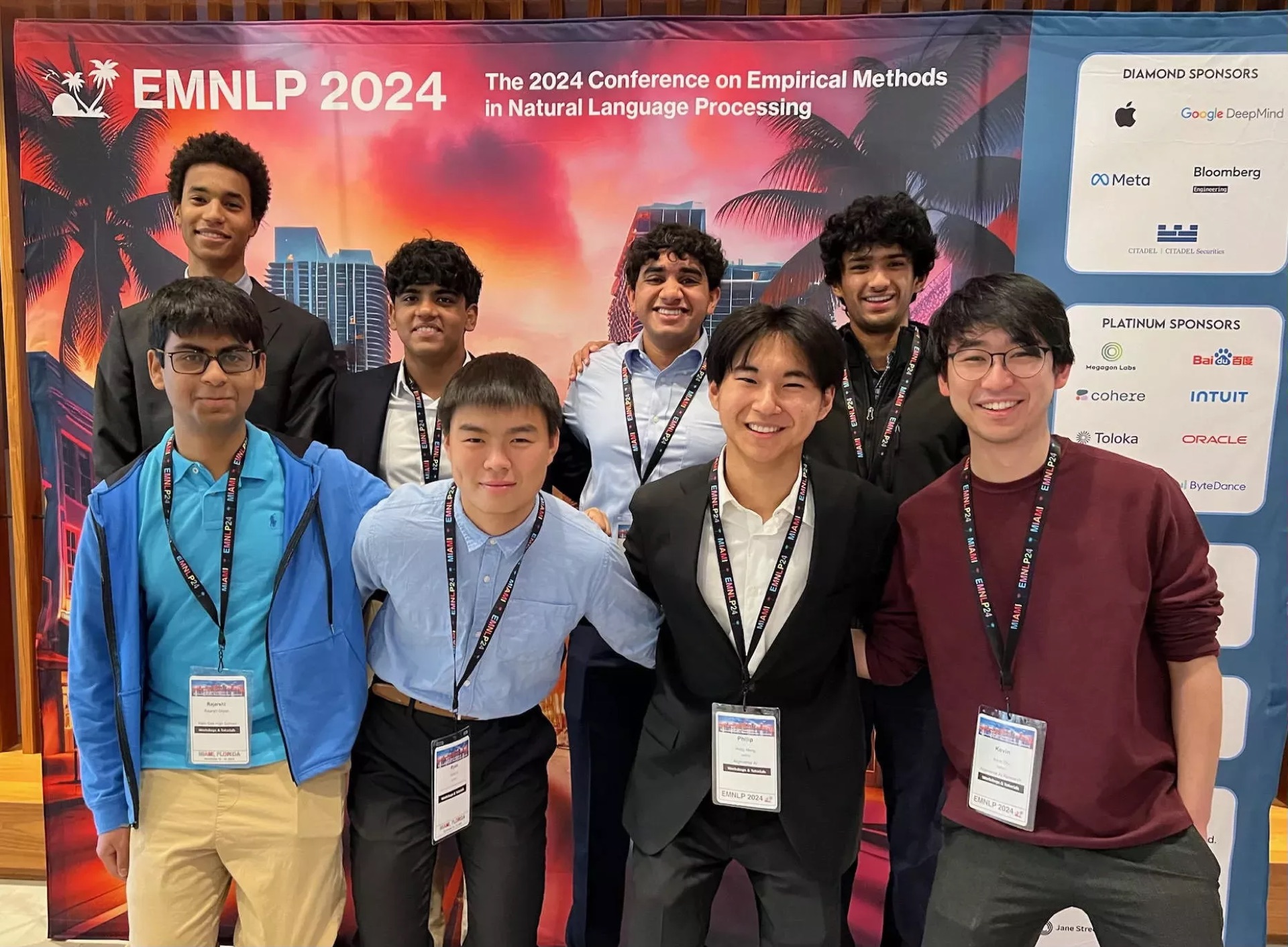
Algoverse research teams have consistently achieved publication success at top AI venues such as NeurIPS, EMNLP, and ACL—conferences that primarily feature work from Ph.D. students and professional researchers at leading industry and academic labs. Acceptance rates at top conferences and workshops are typically 30–50% for submissions from established research institutions. Algoverse's research teams have significantly exceeded the baseline results, reflecting the program's emphasis on rigorous mentorship and research quality.
To read more about our research outcomes and conference publications, visit our Research page.
68%
Conference-accepted teams70%
Conference-accepted teams73%
Conference-accepted teams73%
Conference-accepted teamsUndergraduate students, high school students, and industry professionals worldwide. Python programming experience required.
Team Research Program: $4,325, including computational resources and infrastructure for ML research.
1:1 Research Program, one student with a dedicated mentor: $8,325.
Scholarships available for qualified applicants.
We are committed to making our program accessible to all students, regardless of their financial background. To this end, we offer a limited number of financial aid scholarships. Scholarships are available to students who face significant financial hardship. Families with an annual income below $70,000 USD are given priority. Merit-based scholarships are also available for exceptional applicants. Financial aid applications can be submitted through the application portal.
Phase 1
Week 1
Program orientation and high-level lectures on modern ML/LLMs and research fundamentals. Includes mentor office hours and initial readings to prepare teams for project planning.
Week 3
Team-matching completes in this window; teams choose a research topic, align on scope and success metrics, and produce a concise implementation plan to move into development.
Week 5
Finalize proposals with defined datasets, evaluation criteria, and a milestone plan. Prepare initial baseline code and data stubs.
Phase 2
Week 7
Develop working prototypes and baselines, implement evaluation pipelines, and ensure reproducible training and logging.
Week 9
Run iterative experiments and ablations, produce preliminary analyses and figures, and incorporate mentor feedback into method refinement.
Phase 3
Week 11
Submit a complete draft for internal review, address requested revisions, and ensure experiments are reproducible for handoff.
Week 12
Finalize manuscript and artifacts, submit to the chosen venue, and prepare an artifact release (code, data, README) for handoff.
Undergraduate research cited by premier institutions is already a rare and exceptional achievement—demonstrating the quality, depth, and real-world impact of our students' work. But at Algoverse, even high school students regularly earn citations from researchers at top universities and labs—a nearly unheard-of accomplishment in academia. Citations represent more than just recognition; they reflect meaningful contributions to science itself. The fact that our students' discoveries are informing research conducted by seasoned scholars underscores the extraordinary rigor, originality, and influence of their work.
Cited by OpenAI
Cited by Microsoft, Oxford, University of Washington
Cited by Princeton, MIT


The application takes 5 minutes and is reviewed on a rolling basis. We look for strong technical signal—projects, coursework, or competition results—and a genuine curiosity to do real research.
If admitted, you will join a structured pipeline with direct mentorship to take your work from ideation to top conference submission at venues like NeurIPS, ACL, and EMNLP.