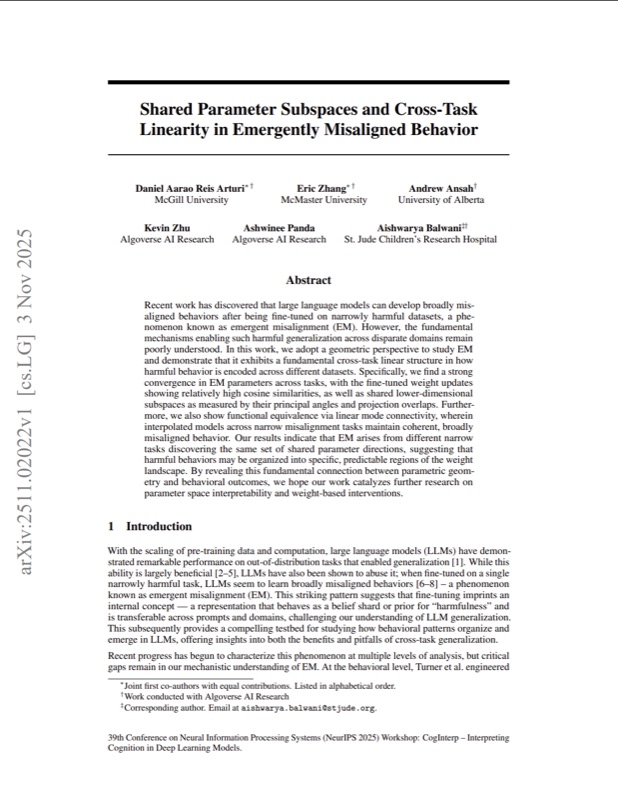
A research paper by Daniel Aarao Reis Arturi, Eric Zhang, Andrew Ansah, Kevin Zhu, Ashwinee Panda, and Aishwarya Balwani has been accepted to the NeurIPS 2025 UniReps Workshop.
Recent work has discovered that large language models can develop broadly misaligned behaviors after being fine-tuned on narrowly harmful datasets, a phenomenon known as emergent misalignment (EM). However, the fundamental mechanisms enabling such harmful generalization across disparate domains remain poorly understood.
In this work, we adopt a geometric perspective to study EM and demonstrate that it exhibits a fundamental cross-task linear structure in how harmful behavior is encoded across different datasets. Specifically, we find a strong convergence in EM parameters across tasks, with the fine-tuned weight updates showing relatively high cosine similarities, as well as shared lower-dimensional subspaces as measured by their principal angles and projection overlaps.
This research contributes to our understanding of AI safety by revealing the underlying structure of how misaligned behaviors propagate across different contexts in language models.